

Article: Deer ked: A flying parasite from the forest – flying ticks in focus

Deer ked: A flying parasite from the forest – flying ticks in focus
The deer ked causes concern every year. As soon as late summer begins, reports of "flying ticks" surface, dogs suddenly start scratching intensely after walks in the woods, and people also report painful bites. But what is really behind this insect, which at first glance seems so harmless but then turns out to be a persistent parasite?
This article provides you with well-founded information, exciting facts and a clear assessment of the risk – for dogs, horses, humans and all four-legged friends who like to be out in the forest.
What exactly is the deer ked?
The deer ked, scientifically known as Lipoptena cervi, belongs to the family Hippoboscidae. Within this family are various louse flies that specialize in feeding on wild animals. Unlike typical insects that only feed on blood briefly, the deer ked lives permanently on its host. Its primary targets are deer, roe deer, badgers, and other wild animals. Wild boar are also among its preferred hosts.
The name "flying tick" is not without reason. Although the deer ked is not a tick species and is not related to the common wood tick, their lifestyles share certain similarities. Both parasites suck blood, both anchor themselves firmly in the skin, and both are difficult to remove once they have attached themselves.
Appearance, physique and special features
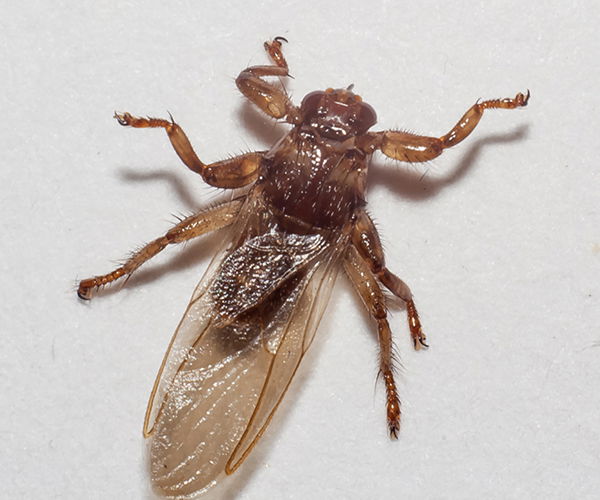
At first glance, the deer ked appears inconspicuous, almost like a small fly. Its body is flat, reddish-brown, has six legs, and is extremely robust. Its strong legs with small claws, which it uses to grip fur or hair, are particularly noticeable. The head is broad, and the proboscis is well-developed and perfectly adapted for bloodsucking.
A distinctive feature is its wings. The deer ked actively flies, usually out of the forest, as soon as it detects a potential host. Once it has reached its target, it sheds its wings. From that moment on, it lives permanently on the animal, crawling through its fur or hair. This very behavior is what makes it so insidious for dog owners.
Occurrence, forest areas and peak season
The preferred habitats of the deer ked are forests and forest edges in Europe, as well as in North and Central Asia. Forest areas with high deer populations offer ideal conditions, as there are sufficient hosts available. In Germany, Austria, and Switzerland, new data on its distribution are collected every year, showing that its range is steadily expanding.
The deer ked's swarming season is in late summer and autumn. The risk is particularly high from about August until October. Warm summers and mild autumns further promote its spread. Experts assume that climate change plays a significant role, as higher temperatures accelerate the insects' development cycles.
Deer ked in dogs – why dogs are particularly affected
Dogs are not typical hosts of the deer ked, but they are frequently targeted. The reason is simple: dogs like to move through forests and undergrowth, precisely where the deer keds lie in wait. As soon as a dog passes by, the insect recognizes its target by heat, movement, and scent and flies directly towards it.
The deer ked crawls lightning-fast through the fur, preferably towards the neck, belly, or behind the ears. There it begins its blood meal. This is extremely unpleasant for the dog. Many immediately show signs of stress, turning frantically or trying to bite or scratch themselves.
Symptoms in dogs
A bite from a deer ked can trigger various reactions. Common symptoms include intense itching, reddened skin, and small pustules. Some dogs are more sensitive than others. In rare cases, inflammation can occur, especially if the dog vigorously scratches the affected area.
Typical signs include:
-
Restlessness immediately after the walk
-
Severe itching, especially on the neck or back
-
Small, hard nodules, pustules or eczema on the skin
-
Increased licking or scratching
-
Stress reactions and discomfort
The deer ked can transmit the bacterium Bartonella schoenbuchensis to dogs, which can lead to fever spikes and skin inflammation.
Deer ked and humans – an underestimated risk
Humans can also be affected. When walking through the woods, deer keds occasionally land on clothing, hair, or directly on the skin. They can crawl through hair and bite humans. The bite is often described as painful and can lead to persistent itching.
In rare cases, the bacterium Bartonella schoenbuchensis, which can be transmitted through the bite, has been detected. This can cause flu-like symptoms. Such cases are rare, but they demonstrate the need for vigilance. Particular attention should be paid if the bite becomes inflamed or persists for an unusually long time.

Deer ked, tick and common wood tick – the differences
Although the term "flying tick" is widespread, the deer ked is not a tick. Ticks, such as the common wood tick, belong to the arachnids, while the deer ked is an insect. Ticks usually wait in grass or bushes and allow themselves to be brushed off, while deer keds actively fly towards their host. They also differ in their body structure: deer keds have six legs, while ticks have eight.
There are also differences in their behavior. Ticks suck blood and drop off after their blood meal. The deer ked, on the other hand, remains permanently attached to its host and feeds repeatedly. This similarity in bloodsucking explains the terminological similarity, even if it is not biologically accurate.
What should you do if your pet is infested?
It's important to stay calm. Deer keds aren't as easy to remove as ticks. Crushing them is difficult because their bodies are very robust. The best way is to use tweezers or wear gloves to carefully pull them out of the fur. Be careful not to crush them with your bare fingers.
After removing the deer ked, disinfect the bite site and monitor the area. If redness, pustules, or persistent itching develop, a veterinary examination may be advisable. A single bite is usually harmless, but multiple bites or severe reactions should be taken seriously. A veterinarian should be consulted if the bite sites become severely swollen, inflamed, the dog develops a fever, or has an allergic reaction.
Prevention: Protection for dogs, horses and other animals
Many dog owners wonder whether spot-on treatments or spot-on preparations are effective against deer keds. The data on this is inconclusive. Some products may have a repellent effect, but do not offer reliable protection. Since the deer ked is not a typical tick, many preparations have limited effectiveness.
Therefore, it's important to be mindful of the risk. After walks in the woods, your dog should be thoroughly checked for flat, brown beetles to detect deer keds. Pay attention to any unusual movements in the fur and to areas where your dog is particularly sensitive.
Horses can also be affected, especially those living near wooded areas. They may exhibit similar symptoms such as itching and skin reactions. Regular checks and careful observation are essential.
Why the deer ked is increasing
Experts see several reasons for the increasing spread. Climate change is causing longer warm periods, which allows the insects to reproduce more effectively. At the same time, wildlife populations are increasing in many regions, providing the deer ked with more hosts. Forest areas are being used more intensively, leading to more frequent encounters between humans, dogs, and wildlife.
All of this increases the risk of the deer ked also ending up on dogs or humans. Therefore, conscious handling, knowledge, and vigilance are more important than ever.
Conclusion: Knowledge creates security
The deer ked is no cause for panic, but it is a parasite you should take seriously. Especially for dogs that enjoy spending time in the woods, it has become a common occurrence in late summer. With a watchful eye, regular checks of your dog's coat, and knowledge of the symptoms and how to react, you can take good care of your four-legged friend.